
Scaling a Romanian Transport Industry Company
Corporate Website & E‑commerce Platform
The project initially focused on the development of a modern corporate website designed to present the company, its services, and its market positioning, while replacing a legacy platform built on technologies dating back to 2007–2010. Following launch, a comprehensive SEO strategy was implemented, centered on continuous content development, on‑page and technical SEO optimization, and local SEO targeting the company’s physical locations.
As the platform matured, and based on our strategic recommendation, an e‑commerce component was integrated to replace the company’s legacy sales system. The previous solution-developed using the Joomla content management system-was limited to partner access only and no longer met modern requirements for scalability, performance, and user experience.
As a direct result of these initiatives, organic traffic increased substantially and the website has since become a national market leader within its segment, outperforming established international competitors. In the first year following the launch of the e‑commerce functionality, total online sales exceeded those generated by the previous system by more than eightfold.
Below is a graphical overview of the website’s growth since project takeover in 2020, illustrating sustained improvements in organic traffic and keyword visibility.
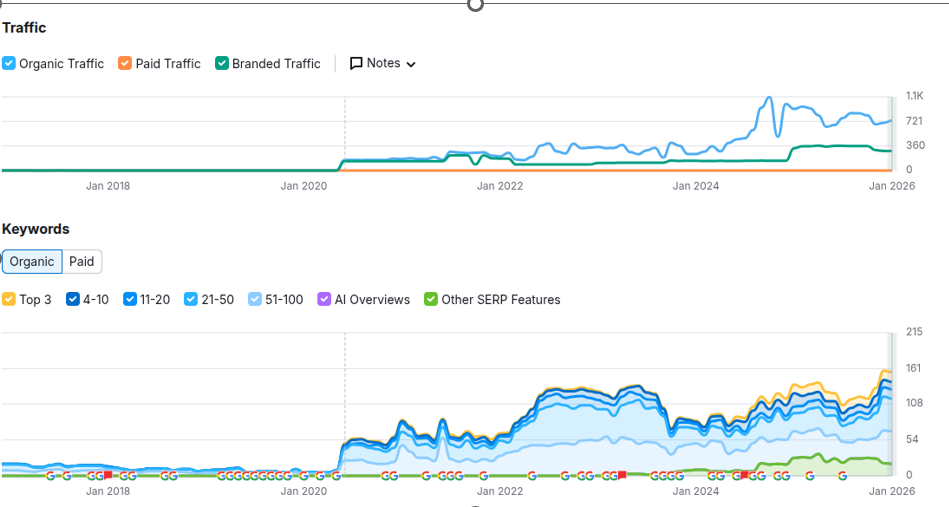
Source: SEMrush (Organic Research Data)
Educational Management Platform
As part of the company’s broader digital transformation strategy, we recommended extending digital management systems to additional operational areas. Following a detailed analysis of the department responsible for technician training and certification-mandatory at the European level-we designed and implemented a dedicated educational management platform tailored to the specific needs of both the organization and course participants.
The platform delivers end‑to‑end functionality, including course management, trainee administration, employer and company management, coordination of in‑person and online training sessions, advanced knowledge assessment mechanisms, and professional certificate issuance. Certificate authenticity and validity are ensured through QR‑code‑based verification. All platform components were developed in full compliance with applicable national and European regulations.
Implementation of the educational management system led to a significant reduction in administrative processing times and enabled a more efficient allocation of internal resources. This directly resulted in a substantial increase in training capacity and annual graduate numbers. In the first six months alone, 249 trainees completed 279 courses, leading to the issuance of 288 professional certificates. By comparison, only 147 trainees completed courses during the year prior to implementation.
Document Generation and Management Platform
A further key digitalization initiative involved the development and integration of an automated document generation and management system supporting technicians operating within partner organizations. The system was designed to replace email‑based workflows, which previously required manual review, classification, and processing by company operators.
Over time, the platform was extended with additional document generation modules, covering multiple document types such as declarations, warranty claims, and other operational and compliance‑related forms.
Following implementation, document processing times were reduced from 1–2 days to under 2 minutes, depending on the user’s internet connection. Operator workload was significantly minimized, with staff now focusing primarily on data validation and analysis through integrated dashboards, charts, tabular views, and statistical reporting tools. In just one month of operation, the system generated and processed 9,421 documents, compared to 28,766 documents processed manually during the entire year preceding implementation.
Secure Document Transfer Platform
To facilitate the secure exchange of information, documents, and technical manuals between internal operators, end customers, and partner companies, we recommended and implemented a secure file management and distribution platform.
The solution incorporates industry‑standard security technologies, including AES‑256 encryption for data protection, multi‑factor authentication (MFA) for user identity verification, and Content Delivery Networks (CDN) to ensure fast, reliable file transfers. These measures elevated data security to enterprise‑grade standards, ensured full compliance with national and European data protection legislation (GDPR), and significantly reduced transfer times-optimizing collaboration and operational efficiency.
Customer Support & Service Management System
Following the deployment of the digital platforms described above, we recommended the implementation of a centralized customer support and service management system to address user inquiries related to products, services, and platform usage.
This solution eliminated the need for a traditional call center model. Instead, AI‑assisted operators handle and resolve customer requests more efficiently than telephone‑based interactions, delivering faster response times, improved resolution quality, and substantially reduced operational costs.
End‑to‑End Infrastructure & Operational Services
In addition to platform design and development, we delivered a complete end‑to‑end service infrastructure to ensure long‑term reliability, performance, and scalability. Our responsibilities included managed cloud hosting, business email services, continuous uptime and performance monitoring, real‑time error tracking and alerting, and advanced traffic analytics and reporting.
This operational framework enables proactive issue detection, rapid incident response, data‑driven decision‑making, and consistently high availability-ensuring an optimal user experience across all digital platforms.
Conclusion & Quantified Business Impact
The digital transformation initiative delivered measurable financial returns, operational efficiencies, and long‑term strategic advantages. Within the first year of launching the new e‑commerce platform, online sales increased by more than 8× compared to the legacy system, establishing a clear and rapid return on investment. This revenue growth was achieved without proportional increases in operational overhead, demonstrating strong operating leverage.
Automation of training, certification, and document management workflows reduced administrative processing times by over 95% (from days to minutes) allowing existing staff to support significantly higher transaction and training volumes. As a result, the organization increased training throughput by over 70% year‑on‑year, issuing 288 professional certificates in six months, compared to 147 certificates across the entire previous year, without expanding headcount.
The implementation of centralized customer support and AI‑assisted service management eliminated the need for a traditional call center model, resulting in materially lower service costs while simultaneously improving response times and service quality. In parallel, the deployment of enterprise‑grade infrastructure, continuous monitoring, and real‑time error tracking reduced system downtime and operational risk, ensuring consistently high platform availability and business continuity.
From a strategic perspective, the company transitioned from fragmented legacy systems to a unified, scalable, and compliance‑ready digital architecture. This transformation strengthened market leadership at the national level, reduced regulatory and operational risk, and created a robust foundation for future growth, product expansion, and potential geographic scaling. By consolidating strategy, execution, and ongoing operations under a single technology partner, the organization achieved faster time‑to‑value, improved governance, and long‑term cost predictability.
Photo by Joey Kyber on Unsplash